
 Call:860-808-1281
So with $300 burning a hole in your pocket for new glass for that new rifle, you know that you want to step up from the sub $200 offerings. Many of those scopes may have more than what you need, but the price has you feeling less confident about their quality. With an assortment of quality rifle scopes available for under $300, we performed an intricate field test to determine, what is the best rifle scope that is under $300?
We revised our standards to give a little bit more variety this time out. The scope had to be suitable to withstand the rigors of 200 rounds of centerfire rifle ammunition without losing zero. It went without saying that all of the scopes had to be rated as waterproof, fog proof and would require multi-coated lenses. However, rather than just look at mere clones of each other in the magnification department, we chose a fixed power scope and one that ran on the lower end of the variable power scale. With that in mind, we chose the following six models…
[go_pricing id=”riflescope-under300″]
The Competitors
Two Burris scopes, two Leupold scopes and two Nikon scopes were chosen this time out.
The target was positioned at 200 yards because, frankly, the 100 yard line is not very challenging for a rifle and it is very easy to shoot sub 1” groups at this range. At 300 yards there are too many external factors that come into play and that gets tiring for a shooter trying to deliver an unbiased review. We determined 200 yards to be the perfect compromise and we ran through each model on each available setting.
The price range ran the gamut from $213 to $299.97; the whole intent was to keep the price reasonable and offer some variation instead of looking at 6 scopes that cost exactly the same with all the same features.
Burris Scout 2.75 x 20mm Heavy Plex Reticle Matte Black Riflescope

The scout scope is a somewhat specialized rifle scope, but they are increasing in popularity between three gun shooters and hunters.
The concept of the scout rifle was first proposed by the late Colonel Jeff Cooper. He wanted a rifle with a specified list of features regarding length, weight, caliber and sights. Specifically he wanted a scope with low magnification and long eye relief mounted forward of the rifle’s action for the purpose of engaging dangerous game or an enemy soldier at close range.
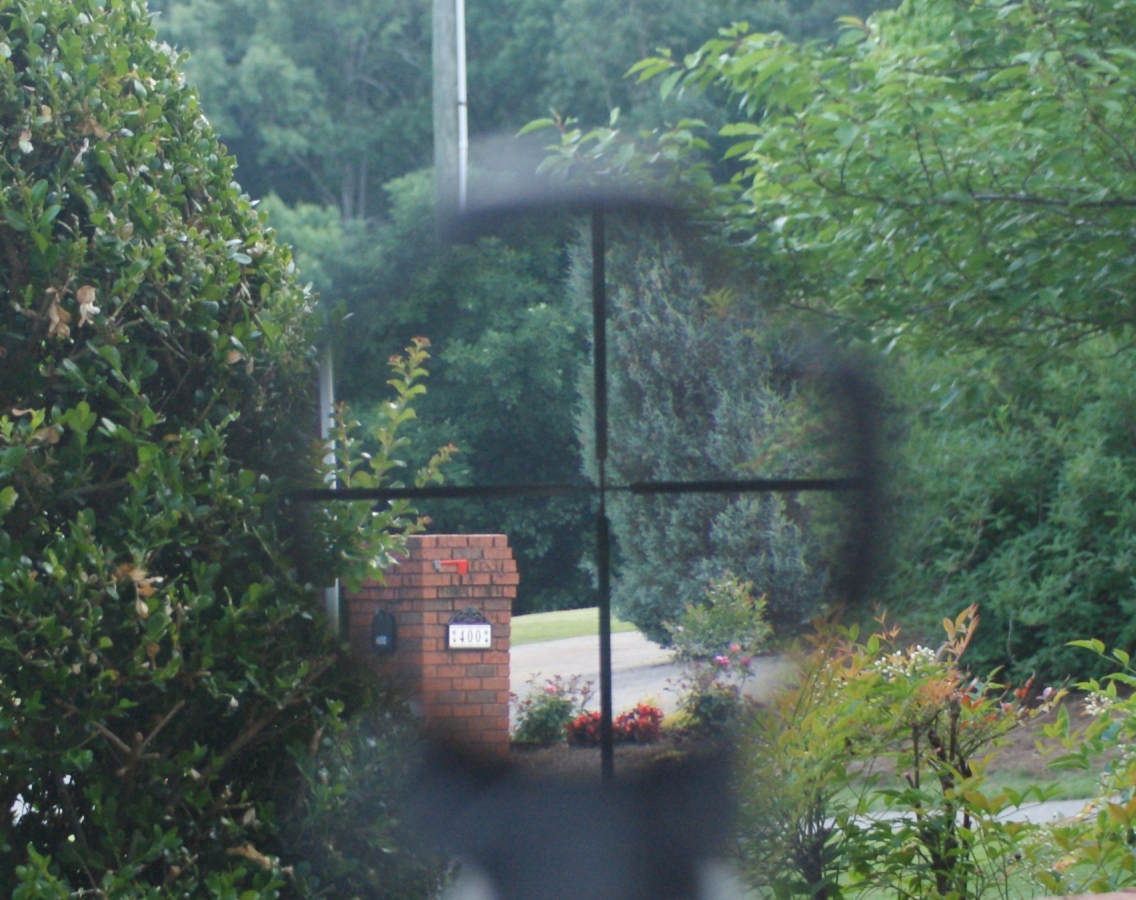
As could be expected from Burris, we were rewarded with clear glass and a crisp reticle. We went a different route with this scope mounted on a Springfield Armory M1A Scout rifle chambered for 308 Winchester (7.62 X 51 NATO). The rifle’s match grade iron sights are capable of reaching out to targets at 1000 yards, so we expected some serious accuracy with the Burris Scout and were not disappointed.
What makes the Scout Scope so effective is the rapid target acquisition due to the long eye relief. Your sight picture is acquired as soon as the butt of the rifle hits your shoulder. Burris’ use of the heavy plex reticle on this model is the key to this type of rapid target acquisition as opposed to other low magnification, long eye relief offerings.

The turrets are capped as they should be for this type of scope and the adjustments are solid and audible. The fixed magnification is good. Most other scout scopes are 1X or 2X, but the 2.75X makes a noticeable difference. Burris scopes have a lifetime warranty, but the primary reason for that is that you will probably never have to call the factory with a problem. These scopes are built to last.
Leupold VX-1 3-9×40 Waterproof Riflescope, Matte Black, Duplex Reticle 113874

Shifting gears from the specialized scout scope, the next rifle scope that was tested was the Leupold VX-1 in 3X9.
This magnification range is the default standard for the majority of hunting applications in North America. You get a low, but not too low 3X setting for close range work and can triple the size of the image by turning the objective ring for farther away or more precise shots.

Leupold typically sets the standard on quality scopes and the VX-1 was no exception. Everything on this scope ran like a well-oiled machine.

The light transmission was nothing short of outstanding and mounted on a pre-64 Winchester Model 70 in 30-06 made for a classic traditional setup.
The lenses were crystal clear and the trademarked Duplex Reticle was bold and provided us with a ragged hole roughly 2.75” in size.
Leupold VX-2 3-9x40mm Rifle Scope, Matte Black, Duplex Reticle 110797

The Leupold VX-2 was the next model we field tested. The VX-2 is said to be an evolution of the VX-1 design and the price reflects that difference. Unfortunately I could not detect any real difference between the two models. Both used turret caps and had identical settings for magnification, tube size (one inch) and objective diameter.
An old adage of purchasing a higher end scope is to look through as many different models as you can and go with what looks clearest or until you can no longer eliminate any differences. That was the case when comparing the Leupold VX-1 to the VX-2. With the same magnification range, finish and objective sizes I could not detect any real differences that would justify the higher price of this model.

That is not to say it was a poor scope. There are slight differences in the manufacturing of the various lines of optics made by Leupold. For example as a custom shop offering the VX-2 offers more reticle choices than the VX-1, but when comparing the two models with the same reticle, there really is no difference. The VX-2 may have been slightly lighter or received an extra type of lens coating, but definitely nothing to make a huge difference.
Like the Leupold VX-1 that we tested, this model utilized the Leupold Duplex reticle. Adjustments were crisp and distinct and the end result was an admirable group on par with the VX-1. If you want a more specialized reticle than the standard Leupold Duplex, this may be the scope to go with as a medium to long range hunting model, but the standard Leupold Duplex is just as adequate on the VX-1.
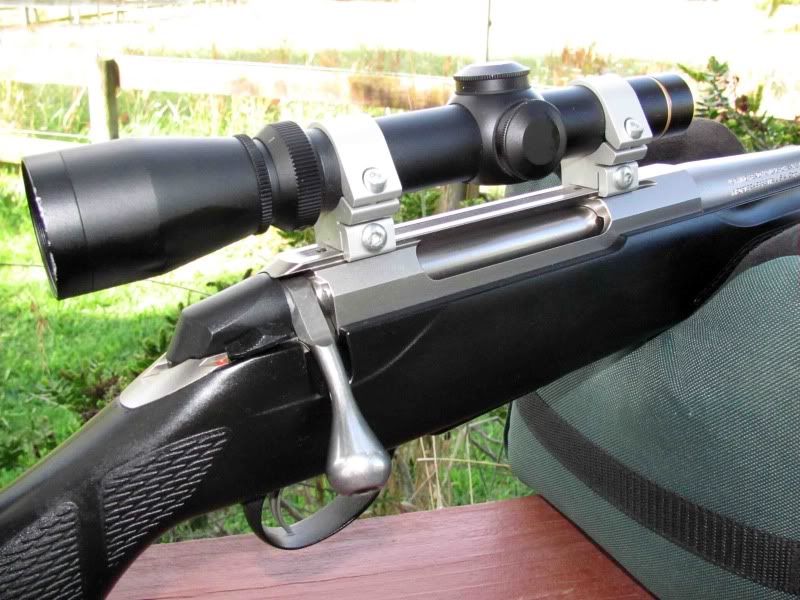
Using the same mounting rings for the VX-1 we installed this scope on the same Winchester rifle chambered in 30-06 and bore sighted. The results were about the same as the VX-1 once we were properly sighted in.
NIKON M-223 8485 1-4×20 Riflescope (Black)

Just like we chose a scout scope in this selection we wanted to provide another non-traditional model in the $300 price range; this time for 3-gun shooters or hunters working at close range with an AR-15 type rifle. The Nikon M-223 represents the next evolution from the P-223 series, specifically designed for AR-15 shooters.

The quality of the glass was on par with the Leupold offerings and the reticle is the company’s patented Point Blank Reticle designed for rapid, yet accurate shooting out to 200 yards with a 55 grain or 62 grain bullet. Nikon promises a 95% transmission of light with this model and I would say that they are right on the money.
Moving from 1X through 4X resulted in a clear image not unlike the company’s famous DSLR cameras. This is perfect for rapid target acquisition on the lower settings and even the 4X proved to deliver in this regard.

The M-223 grants a bit more eye relief than the other models and delivered a group of 1.45” at 200 yards with its 4 MOA reticle. I think it goes without saying that if you are looking for a dedicated scope for use on a rifle chambered in 223 Remington or 5.56 NATO for a 3-gun match; this may be the one that you want.
Burris 4.5 x-14 x -42mm Fullfield II Ballistic Plex Riflescope

We started our testing with a scope that had the largest objective at 42mm. The Burris Fullfield II is a variable powered scope in the 4.5-14X range and uses the company’s patented Ballistic Plex reticle.
The Ballistic Plex reticle uses a lower vertical crosshair with small ballistic lines that automatically compensate for bullet drop from 100 to 500 yards for many common cartridges. Once you zero your rifle, it is fairly intuitive to use these settings and be “close enough for government work”.

On the negative side, we noticed that there is no separate adjustment ring to change magnification settings. With this model, you need to turn the entire eye piece to dial up the magnification. This can be distracting when using a spring loaded lens cover such as those made by Butler Creek, but it is a small sacrifice to make when stepping up to a scope of this quality without paying an extra $200. I found it easier to just remove the cap altogether.
We mounted this scope on a Weatherby Vanguard model chambered in 30-06 and the 14X setting made all the difference in the world. Our target looked like it was on an IMAX screen.
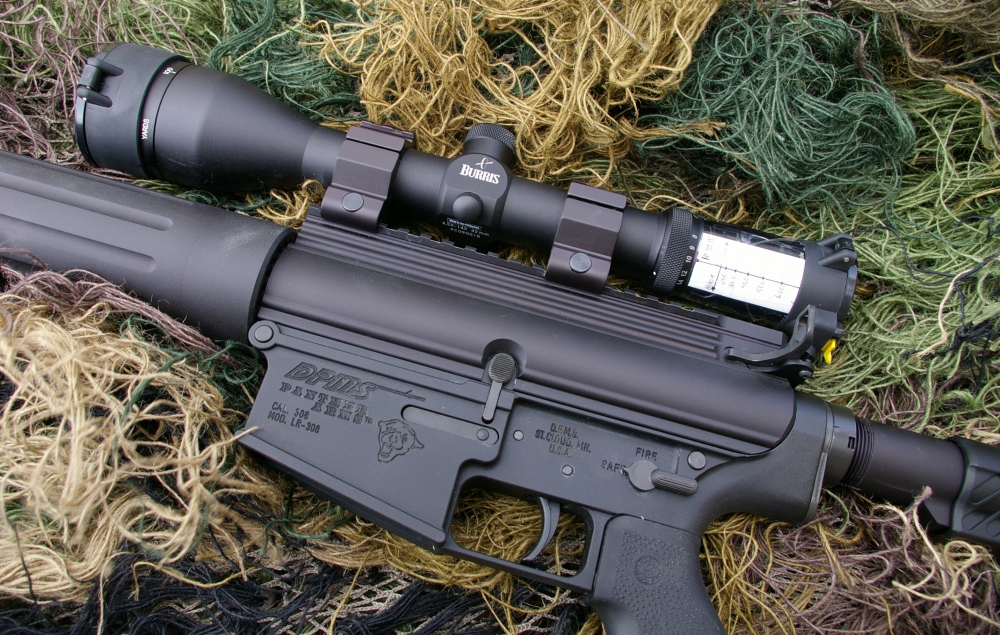
The 42mm objective lets in a lot more extra light than you would think and resulted in one of the clearer scopes we looked through this day. You could almost write your name with the shots and the Weatherby with this scope produced a sub 2” group for us at 200 yards.
Nikon Buckmaster 4.5-14×40 Riflescope

Our final contender was another Nikon model, the Buckmaster in 4.5 -14X range. This is more of a traditional hunting scope with turret caps to protect your adjustment settings and was more on par with the Burris as opposed to the Leupold’s and their standard 3X9 ranges of magnification.

As with the Nikon M-223, you are granted crystal clear glass and excellent light transmission. The Nikon Buckmaster is said to be the brightest scope that the company offers and uses a bullet drop compensator (BDC) reticle for easy holdover out to 600 yards to provide fast, simple aiming points for various distances. This proprietary system uses a series of small “ballistic circles” to provide an uncluttered field of view. It is designed for use with Nikon’s Spot On ballistic software. This downloadable app allows you to determine ballistics for just about any cartridge you can think of. It can run on a computer, tablet or smart phone.
The real strong point on this model is the excellent bullet drop compensator giving you unlimited options for ballistics on a wide variety of rifles and loadings. This scope is rated for use on rim fire, centerfire, muzzle loader and even the powerful 458 Winchester Magnum.

We did not go for the Mauser chambered in 458 Winchester Magnum this time but did mount the scope on a Ruger American rifle chambered in 243 Remington. A cartridge like this is powerful and fast and extremely flat shooting. The group size was just less than 3” at 200 yards using the 14X setting.
The winner
Using a variety of scopes with different purposes made for some interesting observations when determining the best value for the shooter. The long eye-relief of the Burris Scout Scope made it a clear choice for those shooting a scout rifle and the Nikon M-223 was a shoe-in for a 3-gun competitor using an AR-15.
The Leupold scopes worked well, but between the Nikon and Burris’ more specialized reticles and longer power range, they simply did not move us. There was no noticeable difference between the two Leupold models, besides $70 in price, despite one being marketed as the superior of the other.
Of the two remaining scopes, each using a variable power range from 4.5 to 14X, the clear winner was the Burris Fullfield with its Ballistic Plex reticle and high end magnification of 14X. The Nikon Buckmaster was no slouch; either, but the Ballistic Plex on the Burris seemed slightly more intuitive than the Nikon’s BDC. A scope like the Burris Fullfield would serve any hunter well who is shooting any game in North America from prairie dogs up to elk. However, if the turning of the eye piece serves as too much of a distraction, the Nikon may be what you want instead.
Sometimes the difference comes down to features, but keeping under $300 will reward you with a scope that will be accurate, rugged and reliable with any of these choices, instead of spending more than what you paid for the rifle.
[go_pricing id=”riflescope-under300winner”]
